
We use Cookies!
Our website uses cookies. We use cookies to offer you a better browsing experience, analyze site traffic, personalize content, and serve targeted advertisements.
Learn more about how we use cookies and how to manage them by clicking "Cookie-settings".
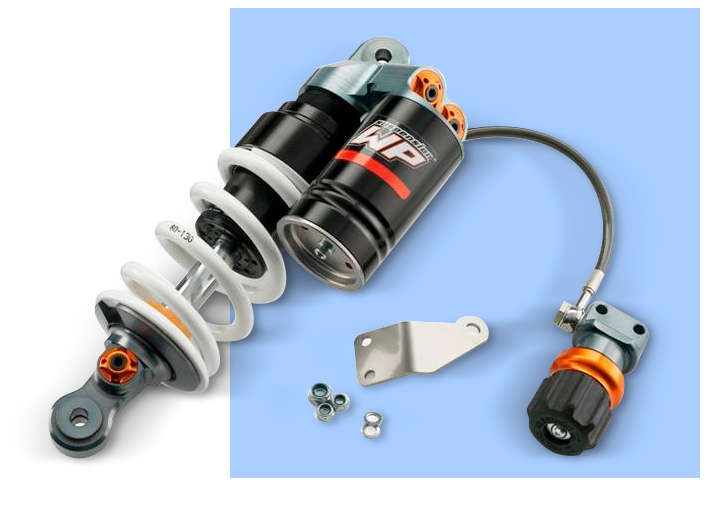
How does a shim stack work in a shock absorber?
A shim stack is a stack of thin metal shims used in a shock absorber or front fork to regulate oil flow. By flexing in a controlled manner under pressure, the shims determine how much resistance the oil encounters. Consequently, the shim stack directly influences the damping and handling of a motorcycle, bicycle, car, or other vehicle with high-performance suspension.
Although a single shim may seem simple, a shim stack functions as a finely tuned system. The diameter, thickness, sequence, material selection, and preload of the shims together determine how the damper responds at low, medium, and high impact speeds.
What is a shim stack?
A shim stack is a package of multiple thin metal shims placed on or around a piston or valve in a shock absorber. These shims partially seal oil ports and flex open when oil pressure builds up.
When the suspension moves, oil is forced through small openings in the damper. The shim stack resists that oil flow. The amount of resistance generated depends on the construction of the stack.
A shim stack usually consists of shims with different:
- Inner diameters
- Outer diameters
- Thicknesses
- Sequences
- Functions within the stack
Together, these shims determine how the shock absorber responds.
Why are shims used in shock absorbers?
In simple dampers, the oil flow is sometimes regulated primarily by fixed openings, also known as orifices. The disadvantage of this is that the damping responds less flexibly to different suspension speeds.
A shim stack operates more dynamically. At low speeds, the shims flex open only slightly or in a controlled manner. At higher speeds and higher oil pressure, the shims can yield further. As a result, a well-designed shim stack can combine comfort, control, and support. This makes suspension shims important in applications such as:
- Motorcross
- Enduro
- Track use
- Mountain bike suspension
- Automotive performance suspension
- Professional shock absorber overhaul
- OEM suspension development

How does a shim stack affect oil flow?
When oil is forced through the piston or valve, pressure is applied to the shims as they flex open in a controlled manner. This creates space for the oil to flow through.
The amount of oil that can move through the system is influenced by: how far the shims open, how stiff the shim stack is, how many oil ports are covered, the speed at which the damper moves, and the pressure generated within the damper.
A stiffer stack offers more resistance to oil flow. A more flexible stack opens more easily and allows oil to pass through sooner.
Low, medium, and high damping speeds
In suspension tuning, the terms low-speed, mid-speed, and high-speed damping are often used. This does not concern the speed of the vehicle, but rather the speed at which the damper compresses or extends.
Low-speed damping
Low-speed damping plays a role in slower suspension movements, for example during braking, acceleration, weight transfer, or cornering. The first shims in the stack, often close to the piston or valve, typically have a significant influence on this part of the damping.
Mid-speed damping
Mid-speed damping lies between small movements and hard impacts. This area is important for control, grip, and support in varying conditions. The way the shim stack gradually opens determines how smooth the transition is between low-speed and high-speed behavior.
High-speed damping
High-speed damping plays a role in rapid damper movements, for example when encountering rocks, roots, braking bumps, hard landings, or sudden impacts. With higher oil pressure, more parts of the stack are stressed, and deeper-seated shims can play a greater role. Important: a shim stack always operates as a single system. It is therefore too simplistic to say that one specific shim is solely responsible for low-speed or high-speed damping. A change to a single shim can affect the entire damping curve.
What role do diameter and thickness play?
The dimensions of a shim determine the behavior of the shim stack. Outer diameterThe outer diameter determines how much surface area the shim covers and how much leverage is generated when the shim bends. A larger outer diameter can have a greater influence on resistance to oil flow. ThicknessThe thickness has a major influence on the stiffness of the shim. A small change in thickness can have a noticeable effect on how easily the shim bends. Therefore, a 0.20 mm shim does not simply behave “slightly” stiffer than a 0.15 mm shim. With thin, spring-like components, a small change in thickness can make a relatively large difference. Inner diameterThe inner diameter determines how the shim fits onto the shaft, bolt, or valve assembly. The correct inner diameter is essential for assembly and operation. Therefore, suspension shims are often referred to as: inner diameter x outer diameter x thickness For example: 8 x 30 x 0.15 mm | 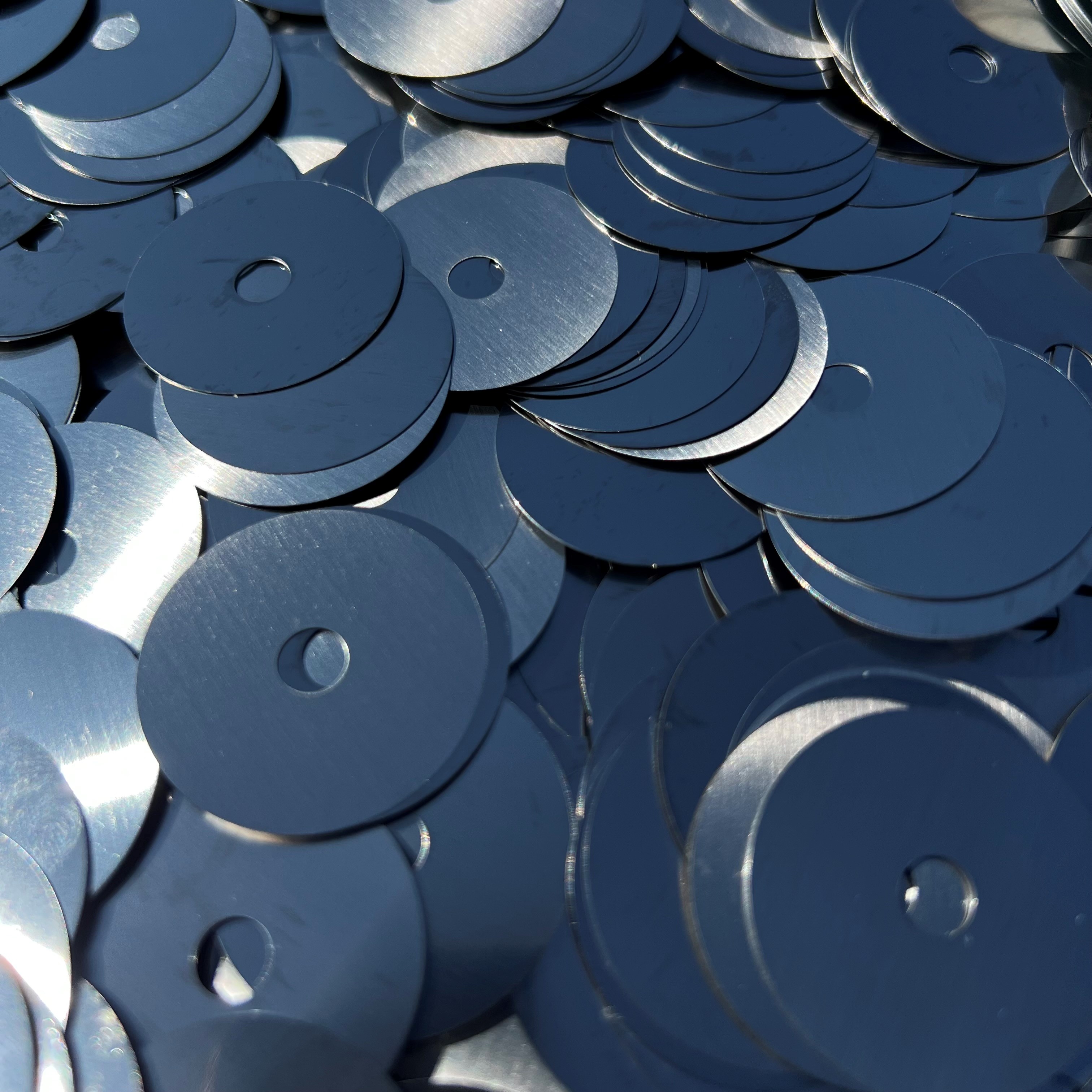 |
Why do tuners often use multiple thin shims?
Instead of one thick shim, multiple thinner shims are often chosen. This provides more possibilities for accurately tuning the stack.
Multiple thin shims can help to:
- Finer modulation of damping;
- Limit permanent distortion;
- Make the transition between different damping rates smoother;
- Adapt the stack more accurately to the application.
This is important for professional suspension specialists, because small adjustments to the stack can be noticeable in handling.
What is a crossover shim?
A crossover shim is a shim used to influence the way a stack opens. A crossover allows a part of the stack to move first before other shims are fully loaded. In simple terms: a crossover shim can help change the transition between different parts of the damping. This allows the damping curve to be made, for example, more linear, digressive, or progressive.
The exact operation depends on the position, diameter, thickness, and combination with the rest of the stack.
What is a ring shim or preload shim?
A ring shim can be used to create preload on the stack. As a result, the stack remains closed longer at low pressure, and more force is required before the shims open.
This can influence the first part of the damping curve. Here too, the effect cannot be viewed in isolation from the rest of the shim stack. The total combination determines the final behavior.
Compression and rebound
Shim stacks are used for both compression and rebound.
Compression
During compression, the suspension is compressed. The shim stack influences how the damper responds to load, impacts, and weight transfer.
Rebound
Rebound causes the suspension to spring back. The shim stack helps determine how controlled the damper returns after compression.
A well-tuned rebound is important to maintain grip and control. Too little rebound damping can cause instability. Too much rebound damping can cause the suspension not to return quickly enough.
Why is material important in a shim stack?
Suspension shims are subjected to continuous dynamic loads. They must be able to bend in a controlled manner thousands to millions of times without losing their effectiveness.
Therefore, material selection and quality are important. A good shim must:
- Be resilient;
- Remain dimensionally stable;
- Resiliently spring back;
- Withstand repeated loading;
- Be manufactured consistently.
ShockShim uses Sandvik 7C27Mo2 hardened spring steel for its shims. This material is suitable for spring-like applications where reproducible performance, corrosion resistance, and reliable dimensional accuracy are important.
Why are tolerances important?
Small deviations can be noticeable in a shim stack. A deviation in thickness, diameter, or flatness can affect how the shim bends and how the stack opens. Therefore, reproducibility is important for suspension specialists, workshops, and manufacturers. If the same stack is rebuilt, the shims used must behave as consistently as possible.
That is why a good shim is not just about the correct size on paper, but also about reliable production and consistent quality.
Suspension shims for professional applications
ShockShim supplies precision shims for use in shock absorbers, front forks, and suspension shim stacks. The shims are available in various inner diameters, outer diameters, and thicknesses and are made from Sandvik 7C27Mo2 hardened spring steel.
View the available shim sizes in the webshop or contact us for custom shims and larger quantities.